Educational notebook
Bohmian Tunneling
Follow a wave packet and its Bohmian trajectories as they meet a finite potential barrier.
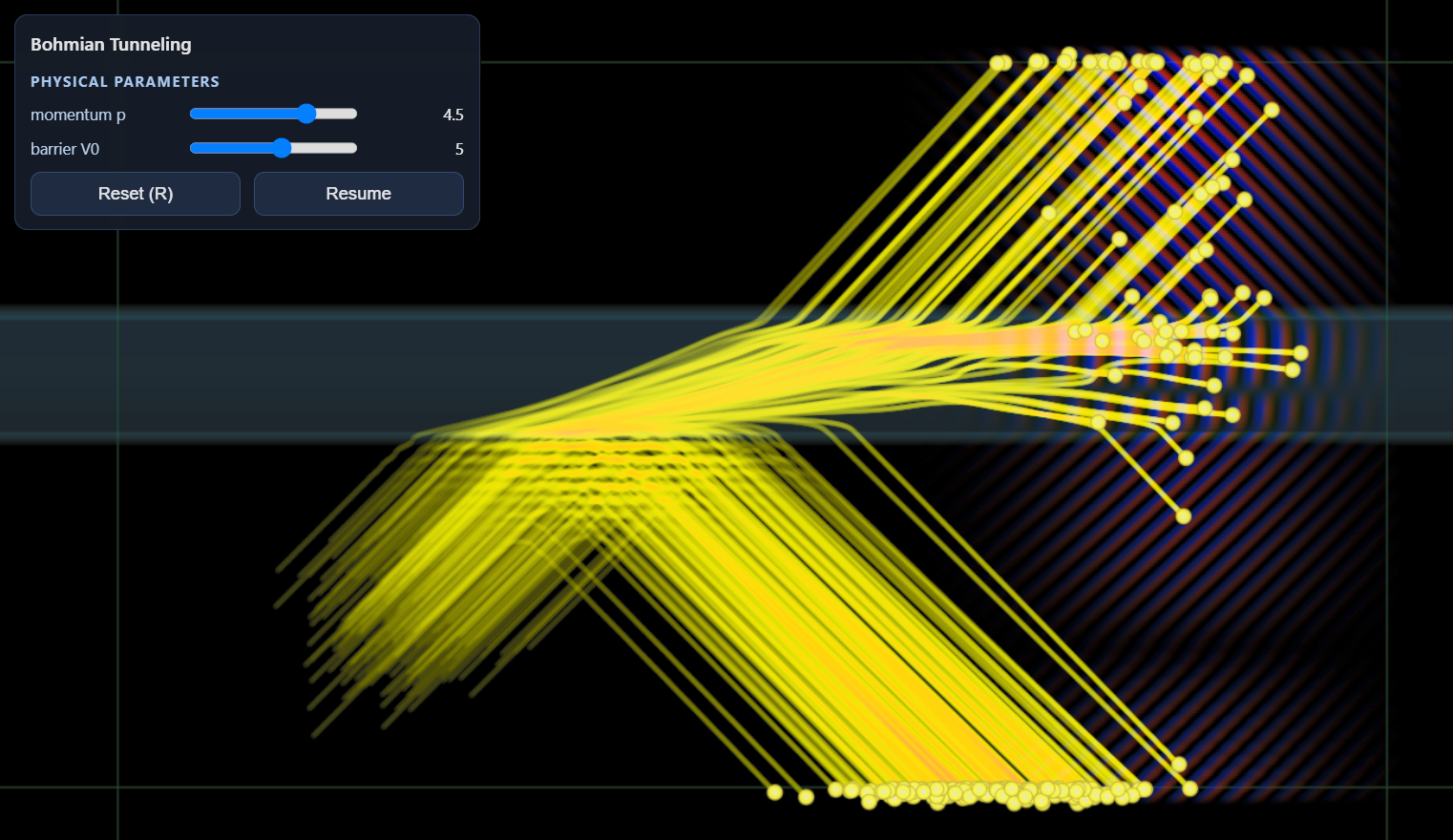
Above-barrier transmission
Begin with an incoming packet whose mean kinetic energy exceeds the barrier height. The barrier still distorts the wave and can produce partial reflection, but transmission is not classically forbidden.
Note, how some reflected particles never even "touch the wall". The reflecting component of the wave pushes them back before they "get in contact".
Some particles almost seem to get "trapped inside the wall" for a time. This happens since there is wave reflection also when "stepping from higher potential to lower one", which is a bit counterintuitive classically.
Adjust the momentum and barrier height to move across the boundary \(E=V_0\).
Incoming packet whose mean kinetic energy exceeds the potential barrier.
Quantum tunneling
When \(E<V_0\), a classical particle cannot enter the barrier region. Classically it cannot pass trough, no matter how thin the barrier is.
The quantum wave instead penetrates the barrier, although the amplitude decays exponentially. Therefore, for a thin enough barrier, a substantial portion of the wave can pass trough! Change the barrier height and thickness to see how strongly they suppress transmission.
The red barrier indicates that its height exceeds the packet's mean kinetic energy.
A larger ensemble
Let us follow a larger ensemble to observe the equivariance in action again. The inital position are sampled from \(|\psi|^2\). displays the reflected and transmitted probabilities.
As usual, the particle density follows the squared modulus of the wave, testifying to the empirical equivalence of the standard interpretation and the bohmian interpretation.
Play with
Equivariance of the two distributions become evident with a larger sample.
Theory and equations
Wave evolution
The packet evolves according to the time-dependent Schrödinger equation:
The finite barrier occupies a region of width \(a\) with potential \(V_0\).
Evanescent penetration
For a stationary component with \(E<V_0\), the wave number inside the barrier is imaginary:
For a sufficiently wide barrier, the transmission probability scales approximately as \(T\propto e^{-2\kappa a}\).
Probability balance
The reflected and transmitted packets are parts of one continuously evolving wave function.
Bohmian guidance
Each particle follows one continuous path into either the reflected or transmitted branch.
Comments and questions
Share a thought about this post or ask a question.