Educational notebook
Bohmian Motion of a Free Particle
A Gaussian wave packet and its Bohmian trajectories.
Intro: From classical to Quantum to Pilot Wave
Newton’s 1st law tells us that a particle in motion will remain in motion at a constant speed and in a straight line if there are no external agents acting on it.
In standard quantum mechanics the point particle is replaced by a wave. The evolution of the wave is described by Schrödinger's equation. Schrödinger’s equation does not immediately describe particles following trajectories. It’s a wave equation. A free particle is therefore represented by the wave solution. The colors here represent different values of the phase.
The wave is not very localized and so intuitively do not represent a particle, whose main property is having a localized position after all.
So what exactly does this tell us about the particle that we eventually detect? Well, the packet’s amplitude—or more precisely the modulus square of the amplitude—at a given location only describes the likelihood of detecting a particle if a detector were placed at that location. For example, in this picture a particle is most likely to be found where the packet is red and has essentially zero chance of being found in locations that are shaded black. This is the Born interpretation of the wave.
If the packet starts off narrow, a particle would be initially found somewhere fairly limited. The spreading packet also tells us that later it would be found in a much wider region. But why is this? Why wouldn’t the particle just move forward like Newton’s Laws predict? Why would a lone particle’s choice to veer off depend on the size of the region of space that you initially chose it in? For that matter, why is it veering off at all? It’s “free” isn’t it?
Clearly something more interesting and subtle is going on here. Sadly, standard quantum mechanics gives little insight.
You see, as we have said, standard quantum mechanics only tells us where we are likely to find a particle if we make a measurement. It makes no predictions about where an individual particle actually is, how it got there, why it moves the way it does, or even if there is an actual particle to be spoken of! Some may even go a bit further and tell you that there is no particle unless and until it is measured. The fact is, the standard approach is very useful for predicting the statistics of measuring an ensemble but it is not very useful for understanding individual particle behavior or the dynamics of the physical process that is unfolding.
The Bohmian Approach to the Free Particle
In the Bohmian view a quantum free particle is still described by a wave packet according to Schrodinger’s equation. Observe how the Bohmian particle always moves such that its velocity is orthogonal to the phase gradient. Basically the particle is surfing the Schrödinger's wave!
Bohmian mechanics allows a very nice gradual transition into classical physics. By increasing the scale, the trajectory starts to resemble the Newtonian free motion more and more.
Playing with Bohmian particle and its wave your self with the following demo. Try narrowing down the inital wave packet and see how it affects the evolution. That is Heisenberg's uncertainty principle in action.
Bohmian trajectories are guided by the local phase gradient.
Many trajectories at once
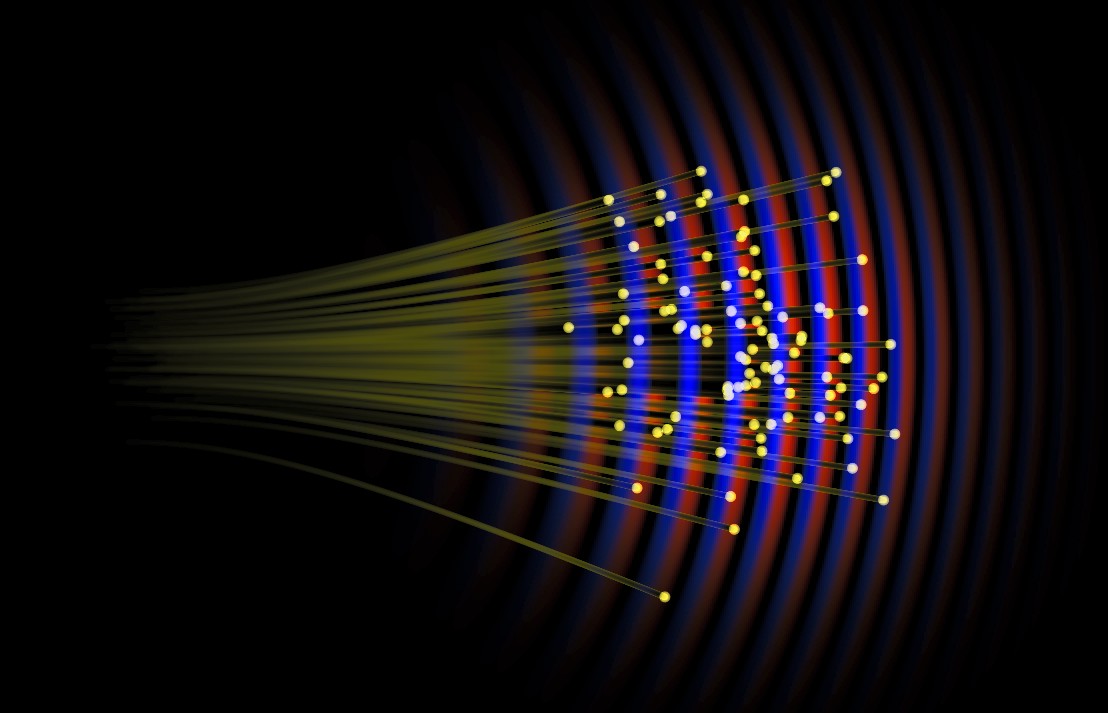
The initial position of a single bohmian particle is distributed according to the wave function's density. We can visualize many trajectories together to see how they collectively represent the evolving quantum flow.
With Bohmian mechanics, we can further visualize the individual particle dynamics by tracking an ensemble of possible initial positions and the trajectory bundle that results. Seeing them animated will help you to develop more intuition and understanding of the dynamics that are inherent in the equations of quantum mechanics, even if you don’t do the calculations yourself yet. For instance, from this trajectory picture we can see a few new things:
- Particles are guided by a flowing and propagating wave, just like streamlines in a fluid.
- Particles follow paths that are perpendicular to the wavefronts, just like rays in optics.
- Particles near the center of the packet tend to move in straight lines.
- Particles near the edges tend to curve away from the packet center despite being “free.”
- Particle speeds are correlated with initial position in the packet.
Even more than this, the trajectories, energies, and velocities can all now be computed and modeled continuously throughout the process giving us an unfolding picture of what the particles could be doing as they navigate through the quantum landscape. Rather than just saying that Newton’s laws are violated, we can see how…and why!
The ensemble expands with the packet while individual paths display the local quantum flow.
This may seem all well and good for a free particle, but isn’t that kind of boring? Well, we can apply these same tools and techniques to help you develop more intuition and understanding of even more interesting and complicated systems, when the free particle becomes “less free” by colliding with a barrier, a slit, another particle, a magnetic field, or even if we include spin. At every stage using this Bohmian picture to supplement the standard one covered in most classes will help you develop a good sense for what so many may have told you is impossible, you can come to better understand how the quantum world behaves.
Asymmetric wave packet
The initial distribution does not have to be symmetric like a single Gaussian. Let us end this lesson with a quick look at bohmian evolution under a double peaked initial distribution. This is still a free particle (apart from the walls), but an asymmetric wave will "drive" the Bohmian particles along more complex trajectories, making them quickly depart from Newtonian vision of inertial movement.
The paths of the Bohmian particles lose their simplicity when the initial wave packet is non-symmetric.
Theory & Equations
Free Schrödinger evolution
With no external potential, the wave function obeys the free-particle Schrödinger equation:
A convenient initial state is a Gaussian envelope centered at \(\mathbf{x}_0\), multiplied by a plane-wave phase with mean momentum \(\mathbf{p}_0\):
Spreading
For this Gaussian convention, the characteristic width grows with time according to
The packet center travels with the group velocity \(\mathbf{v}_{\mathrm{g}}=\mathbf{p}_0/m\), while the increasing width represents quantum dispersion.
Bohmian guidance
Writing \(\psi=R e^{iS/\hbar}\), the Bohmian velocity is determined by the local phase gradient:
The density \(|\psi|^2\) describes the distribution of positions, while the phase controls their local velocity. As the free packet spreads, its phase develops the spatial variation that drives neighboring Bohmian trajectories apart.
Comments and questions
Share a thought about this post or ask a question.